The Unintentional Business Lesson Bali Has Taught Me

Bali has been my home base for over five years now.
When I moved here, I expected to learn many things. Business lessons weren't one of them.
But over the years, living here has taught me something that I see many intuitive coaches, healers, and practitioners struggle with in their businesses.
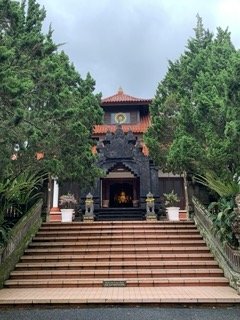
A few years ago, I started going to meditate at Vihara Dharma Giri, a beautiful Buddhist temple in the Pupuan area of Bali.
I first heard about it from my landlord, who recommended visiting it when I happened to be in the area. I didn't get a chance to visit that first time, but the temple kept popping into my head and "calling" me. When a few other people mentioned it as well, I figured I should probably pay attention and go.
The first time I arrived, I immediately understood why I had been drawn there and why people recommended it. The energy of the place was beautiful, and I had a very special meditation experience.
Eventually, I started making the long drive regularly just to meditate there and would often stay overnight at a friend's nearby resort so I could visit the temple two days in a row.
A while later, a close friend came to visit Bali, and I decided to take her there.
We drove to the temple, and when we arrived, the entrance gate was closed.
A staff member explained that there was a silent retreat taking place and visitors were not allowed inside.
At that point, most people would have thanked him for his help, turned around, and gone home.
To be fair, that would have been the reasonable thing to do.
But by then, Bali had already taught me something important.
In Bali, "no" doesn't always mean "no."
Sometimes it means:
"I don't have a solution."
"I don't have the authority to decide."
"This isn't possible right now."
Or simply:
"You need to talk to someone else."
So instead of leaving, I continued the conversation.
With my limited Indonesian, I explained that we had driven two hours to get there. (To be completely honest, it was probably closer to 1.5 hours, but sometimes you need to round these things up a little when making your case. 😄)
I explained that we weren't there to sightsee. We simply wanted to sit quietly and meditate at the temple for thirty minutes.
The manager came over and told us the same thing.
It wasn't possible to visit the temple that day.
So I explained again that we had come a long way specifically to meditate there.
By this point, I think the drive had already grown to well over two hours. 😄
Eventually, we were told that if we were willing to wait about twenty minutes, the retreat participants would be having lunch, the temple would be empty, and we could go in.
We were thrilled and happily waited.
And we ended up having beautiful individual meditation experiences at the temple.
As we were leaving, we asked the same staff member if we could return the next day at exactly the same time for another thirty-minute meditation.
This time the answer was yes.
The interesting part, however, isn't the temple.
It's how often I see the exact same thing happening in business.
Many intuitive practitioner and entrepreneurs encounter a single obstacle and immediately assume it means they should stop.
A post gets little engagement.
Someone doesn't reply.
A potential client says no.
A workshop gets fewer registrations than expected.
A marketing approach doesn't work the first time.
And the conclusion becomes:
"It's not meant to be."
"The universe is redirecting me."
"I should trust the sign."
Sometimes that may be true.
But often it isn't.
Sometimes the obstacle isn't a sign to stop.
It's simply information.
Sometimes the answer isn't "no."
It's "not yet."
Or "try a different approach."
Or "talk to a different person."
Or "adjust something and try again."
One of the biggest differences I see between practitioners and entrepreneurs who eventually build sustainable businesses and those who stay stuck is not intuition.
It's persistence.
Not stubbornness.
Not forcing things.
But the willingness to stay engaged with a situation long enough to find out whether the first answer was actually the final answer.
Intuition is incredibly valuable.
But it works best when it's combined with practical action, curiosity, and a willingness to test assumptions.
Sometimes the sign isn't telling you to stop.
Sometimes it's simply inviting you to look a little deeper before deciding what the situation actually means.